Wearable VLA Robotic Arm for Assistive Tasks
VLAs
Embedded Systems
Robotics
Computer Vision
Python
Collaborators: Dr. Patrick Slade (PI), Alex Ko
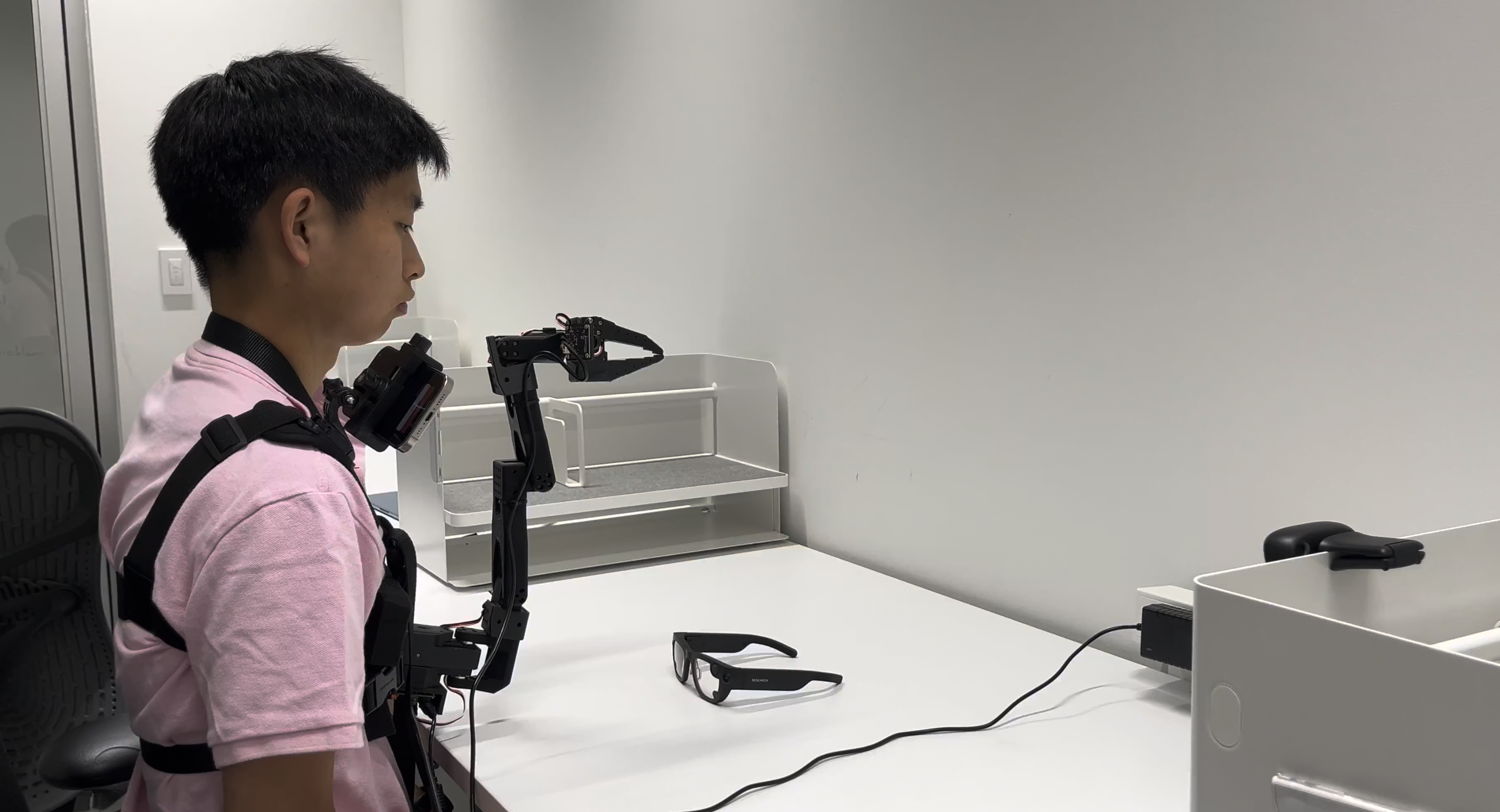
Developed a wearable supernumerary robotic arm platform to evaluate Vision-Language-Action (VLA) models on Activities of Daily Living (ADL) tasks requiring direct human interaction.
Hardware Adaptation & Safety
- Wearable Harness Integration: Adapted an open-source LeRobot SO-101 arm onto a body-mounted harness to function as a wearable assistant.
- Mechanical Hard-Stops: Integrated physical range-of-motion limits on the arm to guarantee user safety during real-time model inference near the human body.
- 1-DOF Proof of Concept: Built an initial 1-DOF prototype with custom Arduino motor control firmware to validate the teleoperation, recording, and inference pipeline before scaling to multi-DOF manipulation.
Egocentric Vision & Data Pipeline
- Smart Glasses Integration: Interfaced Meta Project Aria Gen 1 smart glasses as the primary vision sensor, writing a Python camera handler to undistort, crop, and stream egocentric video into the SmolVLA pipeline.
- Teleoperation & Dataset Curation: Built a synchronized data recorder logging camera frames, joint telemetry, and natural language prompts, curating a dataset of 10,000+ labeled egocentric frames.
Model Fine-Tuning & Evaluation
- SmolVLA Fine-Tuning: Fine-tuned the SmolVLA model on the custom egocentric dataset for target assistive tasks (e.g., grasping glasses and handing them to the user).
- Experimental Protocols: Designed human-in-the-loop evaluation protocols with varying levels of task complexity and human motion to quantify model reliability under realistic operating conditions.
Videos
Task: Pick up the glasses and hand them to me
(Proof of Concept) Task: Point to the glasses